
Your basket is waiting for a little joy.
You haven’t added any treasures yet.
Explore the collectionsLeaf Notes · 3
By Jules & Polly
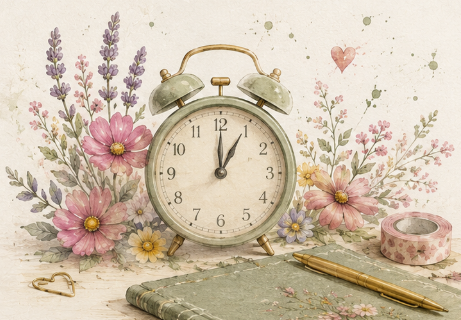
You've discovered what journalling can be and how taking time to put pen, paper and creativity together can give us a welcome opportunity to pause.
But what happens after those first few pages?
It's easy to begin a new journal full of enthusiasm. We buy a beautiful notebook, gather our favourite pens and papers and promise ourselves that this time we're going to use it regularly.
Then life happens… A few days pass, perhaps a few weeks, and the journal stays closed. Before long, something that was meant to bring us pleasure can start to feel like another thing we should be doing.
But journalling should never become another item on your to-do list.
There is no perfect routine and certainly no rule that says you must journal every day. For some people, journalling becomes a daily ritual. For others, it's something they return to at weekends, on quiet evenings or whenever they feel the need to write, reflect or create.
The secret is finding a rhythm that works for you.
Think of your journal as somewhere that's always available to you – a place you can return to when you want a little creativity, reflection, memory-making or simply some quiet time with beautiful things.
No pressure. No rules. Just your journal, your way.
Your journalling rhythm should fit around your life – not the other way around.
Some people love journalling first thing in the morning, perhaps while enjoying that first cup of tea or coffee. Others prefer the evening, using their journal to unwind after a busy day. You might enjoy a leisurely Sunday afternoon surrounded by papers and pens, or find that ten minutes here and there suits you perfectly.
Experiment with different times and places and notice when journalling feels most enjoyable.
One way to make journalling easier to return to is to make the experience itself something you look forward to. Find somewhere comfortable. Make your favourite drink. Put your phone aside for a few minutes and gather some things you'd like to use.
You could even create a little journalling basket or box containing your current journal, favourite pens, scissors, glue, washi tape and a handful of papers and embellishments. Keeping everything together means you can simply pick it up whenever inspiration strikes.
And don't hide all those lovely stationery treasures away!
Keep a favourite notebook or pen somewhere you'll see it. Sometimes that visual reminder is all we need to think, I'd quite like ten minutes with my journal.
We can sometimes imagine that journalling requires lots of time, but it really doesn't.
Write one sentence. Add a photograph. Stick in something you've saved. Doodle around a favourite quote. Make a tiny collage or simply choose a few colours and make some marks.
Five minutes may become twenty – or it may remain five.
Both are enough. Small moments of creativity still count.
We've probably all experienced that moment: you open a beautiful new page, pick up your pen… and suddenly your mind goes completely blank.
Don't let the blank page intimidate you. It isn't expecting anything!
You don't need an important thought or an interesting story before you begin. Often the simplest observations make wonderful journal entries.
Try finishing one of these sentences:
You could write several paragraphs – or answer in just a few words.
And remember, journalling doesn't always have to involve writing.
Choose something from your Polly's Paper Garden collection and simply play.
Layer some papers. Add stickers or washi tape. Make a collage from colours and images you love. Stick in a photograph, ticket, postcard or little keepsake. Add doodles, borders or marks around the page.
Don't worry about whether everything coordinates or whether somebody else would think your page looks beautiful. This isn't a competition and it doesn't need to be shared on social media. It belongs to you.
Sometimes creativity comes after we begin rather than before. One scrap of paper suggests another; a sticker inspires a colour; a photograph reminds us of something we'd forgotten.
You don't always have to know where a page is going. Start somewhere and let the page lead you.
Perhaps the most important thing to remember is this: You cannot fall behind with your journal.
If you haven't opened it for a day, a week or even a month, you haven't failed. There are no missed pages and nothing to catch up on.
Your journal isn't keeping score. It will simply be waiting whenever you're ready to return.
Some weeks you may write often, others you might prefer creative pages, and sometimes your journal may stay closed. That's perfectly okay.
Not sure where to begin? Give yourself just five minutes.
Choose something you love – a pen, piece of paper, sticker, photograph or embellishment – and put it on the page.
Add a word, a date, a doodle or another layer if you feel like it.
Then stop whenever you want to.
The process is the point.
Five minutes before bed, an hour on Sunday or occasional bursts of creativity – your rhythm is entirely your own, and it can change as life changes.
What matters isn't how often you journal, but that it remains somewhere you want to return to, rather than somewhere you feel you ought to.
Your journal is always there when you need it.
Jules & Polly x
Plant thoughts with kindness, nurture them with reflection and watch yourself bloom.